
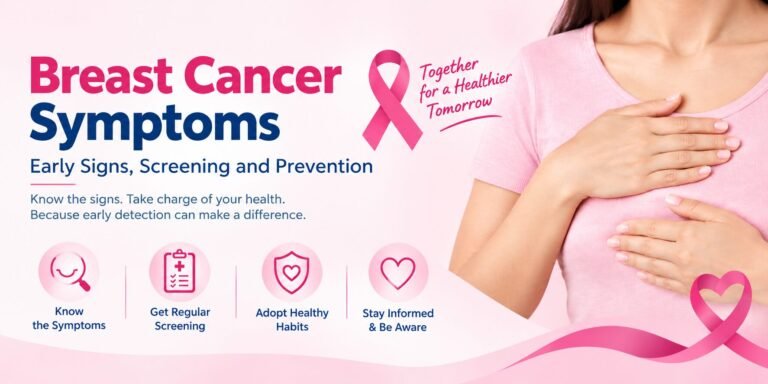
Knowing the Breast Cancer Symptoms can help you understand when to seek medical advice. October is Breast Cancer Awareness Month, which many people call “Pinktober.” It is a good time to learn more about breast health. Many women feel worried when they hear the word cancer, and that feeling is natural. Learning the basics can make the topic feel less scary. The World Health Organization (WHO) says breast cancer is one of the most common cancers in women worldwide.
Finding it early may give patients more treatment options. Treatment options and outcomes vary with the type and stage of the cancer, so each person needs advice from a doctor who knows her case. Many women do not know the early signs, and some feel shy about talking about their breasts.
This blog explains what breast cancer is, which signs to look for, who has a higher risk, how doctors check for it, and which habits may lower the risk. Share it with the women in your family and your circle of friends.
What Is Breast Cancer?
Before we look at the signs, it helps to know what the disease is.
Our body is made of tiny parts called cells. Cells grow, do their job, and then die. In breast cancer, some breast cells change and grow without control. They can form a lump or other abnormal growth.
Most breast cancers start in the milk ducts or the lobules, which are the glands that produce milk. Some breast cancers can spread to other parts of the body through the blood or lymphatic system. Lymph nodes are small, bean-shaped structures that are part of the immune system.
Men have a small amount of breast tissue too, so men can get breast cancer as well, though this is rare.
The Pink Ribbon and Pinktober
Every October, hospitals, schools, offices, and local groups hold camps and talk about breast health. People wear a pink ribbon to show support for those affected by breast cancer and to raise awareness about breast health and screening.
The month has a clear purpose. It helps end the shame and silence that stop many women from speaking up. Some women hide a lump because they feel shy or fear what others will say. Awareness drives teach that a check-up is a normal part of health care and nothing to feel embarrassed about.
Early Signs You Should Not Ignore
Women show different signs, and some women show none at all. These are some breast changes that should be discussed with a doctor. Each one needs a medical check, even if it does not hurt.
- A lump or thick area in the breast or armpit: The lump may feel hard and uneven, or it may feel soft and round. The feel of a lump alone cannot tell whether it is cancer. Only a medical test can do that.
- A change in size or shape: One breast may grow bigger, hang lower, or look different from the other. Small differences between breasts are normal. A new or noticeable change should be checked by a healthcare professional.
- Skin changes: Look for dimples, puckering, or skin that looks like an orange peel. A tumor under the skin can pull on the tissue and cause these marks.
- Nipple changes: A nipple that turns inward, or one that gets a new rash, scales, or crust, needs a check.
- Nipple discharge: New or unusual discharge should be checked by a doctor. Bloody discharge or discharge from one breast should be evaluated by a doctor. Discharge has many causes, and a doctor can find the right one.
- Swelling, redness, or pain: A breast or nipple that swells, turns red, feels warm, or hurts for no clear cause should be seen by a doctor.
A Painless Lump Can Still Be Cancer
Breast cancer can occur without pain, so the absence of pain does not rule it out.
Early breast cancer may cause no pain at all. A painless lump can be cancer, and a painful breast is not always cancer. A lump or swelling in the armpit can have several causes, including changes in the lymph nodes, and should be checked by a doctor. A new change in the appearance or texture of the breast skin should also be checked. If you notice a new or unusual change, contact a doctor. Do not wait for pain before you seek medical advice.
Who Has a Higher Risk of Breast Cancer?
Anyone can get breast cancer, but some people face a higher risk than others.
- Age: The risk of breast cancer goes up with age.
- Family history: If your mother, sister, or daughter had breast cancer, your risk may be higher. Changes in genes such as BRCA1 and BRCA2 can pass from parent to child and increase the risk of breast cancer.
- Extra weight after menopause: After menopause, extra body weight can raise the risk of some breast cancers.
- Alcohol and smoking: Both are linked to several kinds of cancer, including breast cancer.
- Physical activity: Regular physical activity is associated with a lower risk of breast cancer.
- Age at first pregnancy: Having a first pregnancy at an older age, or never being pregnant, can be associated with a slightly higher risk of breast cancer.
Having one or more of these points does not mean you will get the disease. Many women with breast cancer have none of them. Knowing your own risk helps you and your doctor plan the right checks.
How Doctors Check for Breast Cancer
Some breast changes cannot be felt by hand, so doctors use tests to look for them.
Knowing the Breast Cancer Symptoms is the first step, but screening goes further. Screening means testing a woman who has no signs. Advice on screening differs by age, personal risk, family history, and the guidelines of your country. Ask your doctor when to start and how often to repeat each test. Here are the main checks:
- Breast self-awareness: This means knowing how your breasts normally look and feel, so you notice a new change early. Look at your breasts in a mirror and feel them from time to time. The goal is to notice any new or unusual change and report it to a doctor.
- Clinical breast exam: A trained doctor or nurse checks your breasts and armpits by hand. Your doctor will tell you if you need one and how often.
- Mammogram: This is a low-dose X-ray of the breast. A mammogram can find some breast changes before they can be felt. Your doctor will suggest when you should start and how often you should repeat it, based on your age and risk level.
- Ultrasound: This test uses sound waves to make a picture of the breast. Doctors may use ultrasound to examine a lump or another area seen on a mammogram. It may also be useful for women with dense breast tissue.
- MRI scan: Doctors may suggest this scan for women at very high risk, such as those with a gene change.
- Biopsy: The doctor takes a tiny piece of suspicious tissue and sends it to a lab. A biopsy is used to confirm whether the tissue contains cancer cells.
Habits That May Lower the Risk
No habit can promise that a woman will never get breast cancer. Some habits, though, are linked to a lower risk and also support your overall health.
- Keep a healthy weight: After menopause, extra body weight can increase the risk of some breast cancers. Eat more fruits, vegetables, whole grains, and pulses, and eat less fried food and sugar.
- Stay active: Walking, yoga, cycling, or dancing all count. Regular physical activity can help maintain a healthy weight and is associated with a lower risk of breast cancer.
- Stay away from alcohol and tobacco: The more alcohol a woman drinks, the higher the risk. Smoking is linked to many cancers, including breast cancer.
- Breastfeed if you can: Breastfeeding may lower the risk of breast cancer, and longer total breastfeeding duration is associated with a greater reduction in risk.
- Go for screening when your doctor advises it: Regular screening, when it fits your age and risk level, can help find breast cancer early.
When to See a Doctor
Many women wait and hope that a change will go away. Please do not wait.
If you notice a lump, a skin change, a nipple change, or any other new or unusual change, contact a doctor. A previous normal mammogram does not rule out a new breast problem. Many breast changes are caused by conditions other than cancer, but a new or unusual change should still be evaluated.
A medical check can help find the cause of the change. If it is breast cancer, treatment options and outcomes depend on the type and stage of the disease. Your doctor will explain the choices, which may include surgery, medicine, or radiation.
Final Words
Breast Cancer Awareness Month is a good time to talk about breast health with the people around you. Knowing the Breast Cancer Symptoms and seeking medical advice when you notice a change can support an earlier diagnosis. Capital Super Speciality Hospital provides medical consultation and cancer-related care for patients who need it.