
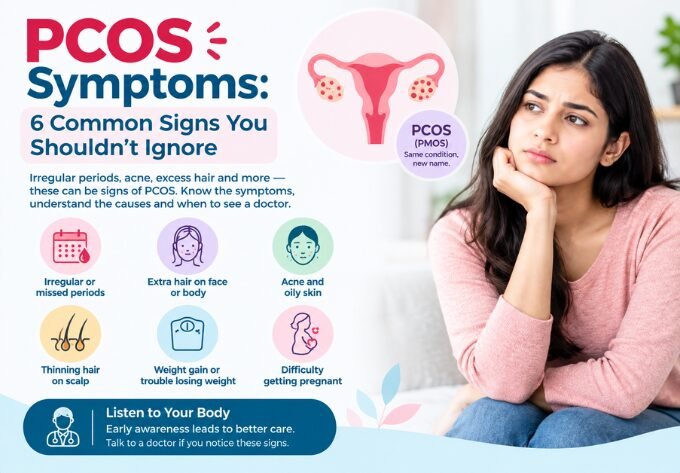
Do your periods come late or skip for months? Do you have acne that will not go away, or hair growing on your face? These can be PCOS symptoms. But they can also come from other health problems.
In this blog, you will learn six common signs of PCOS, what may cause it, how doctors check for it, and when to see a doctor.
What Is PCOS?
PCOS is a common hormone condition in women of childbearing age. In PCOS:
- The ovaries may not release an egg every month. This is why periods can become irregular.
- The body may make more “male hormones” (androgens) than usual. Every woman has some of these hormones. Too much can cause acne and extra hair.
- Many women also have insulin resistance. This means the body does not use insulin well. Insulin is the hormone that controls blood sugar.
The word “polycystic” can be confusing. Many women with PCOS do not have real ovarian cysts. The ovaries may show many tiny fluid-filled sacs on a scan. These are small egg-holding sacs called follicles. They are not harmful lumps.
6 Common PCOS Symptoms
PCOS looks different in every woman. You may have only one or two of these signs, or several.
1. Irregular or missed periods
This is one of the most common PCOS symptoms. Doctors usually look for these patterns:
- Periods that come more than 35 days apart
- Fewer than eight periods in a year
- Periods that stop for several months (when you are not pregnant)
In the first few years after a girl’s first period, irregular cycles are common and may be normal. A doctor can tell you if there is a concern.
2. Extra hair on the face or body
Some women notice thick, dark hair on the chin, upper lip, chest, belly or back. Doctors call this hirsutism. It happens when androgen levels are higher than usual.
3. Acne and oily skin
Acne that continues after the teenage years, keeps coming back, or appears on the jawline and chin may be linked to hormones. Oily skin is also common.
4. Thinning hair on the scalp
Hair on the head may become thin, especially at the top or front. The parting may look wider. At the same time, hair may grow thicker on the face. This can be upsetting. Please know that treatment options exist.
5. Weight gain or trouble losing weight
Many women with PCOS gain weight around the belly and find it hard to lose. Some also see dark, velvety patches of skin on the neck or underarms. This can be a sign of insulin resistance.
But PCOS is not only for women who are overweight. Slim women can have PCOS too.
6. Difficulty getting pregnant
If ovulation (release of an egg) does not happen regularly, it can take longer to become pregnant. Some women find out about PCOS for the first time when they visit a doctor about this problem.
Other things some women notice
Some women also feel tired, low in mood or anxious, or have poor sleep. These are not used alone to diagnose PCOS, but they matter. Please share them with your doctor.
Does One Symptom Mean You Have PCOS?
No. Each of these signs can have other causes. For example:
- Thyroid problems
- High levels of a hormone called prolactin
- Stress, very low body weight or sudden weight change
- Some medicines
- Other hormone conditions
- Pregnancy (if a period is missed)
This is why self-diagnosis is not a good idea. A doctor needs to look at the full picture.
What Causes PCOS? Who Is at Higher Risk?
The exact cause is not fully known. Doctors believe these factors play a role:
- Insulin resistance: High insulin can push the ovaries to make more androgens.
- Hormone imbalance: Higher androgens can stop regular ovulation.
- Family history: PCOS can run in families. You may be at higher risk if your mother or sister has it.
- Extra weight: It does not cause PCOS on its own, but it can make symptoms worse.
PCOS is not your fault. It is not caused by something you ate or did.
How Do Doctors Check for PCOS?
There is no single test for PCOS. A doctor usually does the following:
- Asks about your health: period dates, symptoms, weight changes, medicines and family history.
- Does a physical check: blood pressure, weight, and signs such as acne, hair growth or skin patches.
- Suggests blood tests: for hormones, blood sugar, thyroid and sometimes cholesterol, depending on your case. These also help rule out other conditions.
- May suggest an ultrasound: to look at the ovaries and the lining of the womb.
Doctors commonly diagnose PCOS when at least two of these three features are present: irregular or absent ovulation, signs or blood test evidence of high androgens, and the typical look of the ovaries on ultrasound. This means an ultrasound alone cannot confirm or rule out PCOS. In teenagers, doctors are usually more careful, because irregular periods are common in the early years.
How Is PCOS Treated and Managed?
There is no single cure for PCOS, but symptoms can often be managed well. Treatment depends on your symptoms and whether you want to become pregnant. Your doctor may talk to you about:
- Healthy lifestyle: balanced meals, regular physical activity and good sleep. If you are overweight, even a small, steady weight loss may help some symptoms.
- Medicines: these may be used to regulate periods, reduce acne or hair growth, improve how the body uses insulin, or help with ovulation. They should be taken only on a doctor’s advice.
- Skin and hair care: treatments for acne, hair growth and hair thinning.
- Fertility support: if you are trying to get pregnant, there are options to help ovulation.
- Emotional support: if you feel low or anxious, talk to your doctor. This is part of good PCOS care.
- Regular check-ups: PCOS can raise the chance of problems such as diabetes, high cholesterol and high blood pressure in some women. The risk is different for each person. Regular checks help find problems early.
Please do not start medicines or supplements on your own, or based on social media advice.
When Should You See a Doctor?
You do not need to wait for symptoms to become severe. Consider seeing a gynaecologist if:
- Your periods are often irregular or have stopped for several months
- You have new or increasing hair on the face or body
- You have acne that does not improve, or hair thinning
- You have been trying to get pregnant and have not been able to
- You have very heavy or unusual bleeding
- You feel worried about your symptoms
Get urgent medical care if you have:
- Very heavy bleeding, such as soaking a pad every hour for several hours, or passing large clots
- Sudden, severe pain in the lower belly
- Dizziness or fainting with heavy bleeding
- Pain or bleeding when you may be pregnant
Consult a Gynaecologist in Yamunanagar
If you live in Jagadhri, Yamunanagar or nearby areas, you can talk to the Obs & Gyne team at Capital Super Speciality Hospital about your symptoms. Before your visit, it helps to:
- Note the dates of your last six periods
- Write down all your symptoms and when they started
- List any medicines you take
- Bring past reports, if you have any
- Note whether anyone in your family has PCOS, diabetes or thyroid problems
You can learn more on our Obs & Gyne department page or see our doctors.
Frequently Asked Questions
Q1. Can I have PCOS if my periods are regular?
It is possible, but not common. Doctors look at your full picture, including hormone signs and tests, before deciding.
Q2. Can PCOS be cured?
There is no single cure at present. But symptoms can often be managed with the right care, and many women live healthy lives with PCOS.
Q3. Can I get pregnant if I have PCOS?
Yes, many women with PCOS become pregnant. Some need help with ovulation. If you want a baby, talk to a gynaecologist early.
Q4. Do I need an ultrasound to confirm PCOS?
Not always. Doctors look at symptoms, examination and blood tests too. An ultrasound is one part of the picture, and it cannot confirm PCOS alone.
Q5. Is PCOS only found in women who are overweight?
No. PCOS can affect women of any body size. Extra weight can make symptoms worse for some women, but slim women can have PCOS too.
Q6. Will PCOS go away after marriage or pregnancy?
Marriage and pregnancy are not treatments for PCOS. Symptoms can change over the years, so regular follow-up with your doctor is important.
Q7. Is PCOS the same as PMOS?
Yes. PMOS is the new name for PCOS, agreed in 2026. It is the same condition.
Conclusion
Irregular periods, extra hair, acne, hair thinning, weight changes and trouble getting pregnant can be signs of PCOS. They can also have other causes, so a proper check-up is the safest step. PCOS can be managed, and getting help early can make a real difference to your health and peace of mind.
To book an appointment: Contact Capital Super Speciality Hospital through the Contact page or WhatsApp +91 81990 08805. OPD hours are Monday to Saturday, 10 AM to 2 PM and 5 PM to 8 PM. Sunday is for emergency services only. The emergency department is open 24/7 (108 / +91 8199008804/05).
Medical Disclaimer: This article is for informational and educational purposes only. It is not a substitute for professional medical advice, diagnosis or treatment. Every person’s health condition is different. Please consult a qualified healthcare professional for advice about your symptoms or medical condition. Do not delay seeking medical care because of information in this article.